

The Amazon Rainforest
Hearing the term rainforest many of you will think of impenetrable jungle full of danger where it is always raining when hearing the word tropical forest. Who didn’t grow up with the adventures of Tarzan (Africa), Mowgli of the Jungle Book (India) and Indiana Jones (Peru)
From experience I can tell that the Amazon is indeed impenetrable, the tropical rain often pours down during an excursion and mosquitos are present in large numbers .
The Amazon Rainforest – tropical jungle
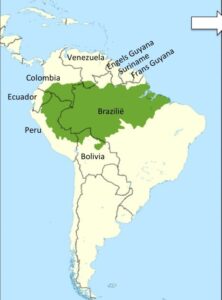
Tropical forest can be found in Africa, Asia and South-America. The Amazon Rainforest in South-America is the largest of all and for various reasons important for the survival of the planet. It is located in the northern part of South-America. It is divided over the following countries: Brazil (60%), Peru (11%), Colombia (8%), Venezuela (7%), Bolivia (6%), Guyana (3%), Surinam (2%), Ecuador (2%) and Frans Guyana (1%). In area it is equal to the continental United States. This jungle is crossed by the Amazon River. This river has a length of more than 6000 kilometers and at the mouth of the river has a width of more than 50 kilometer. When you are sailing at the middle of the river you cant see the shores and it looks like you are sailing on open sea. A strange sensation!
Biodiversity
Despite the fact that the Amazon covers less than 10% of the surface area the biodiversity is unparalleled. Here are a couple examples to show how many plant- and animal species it harbours. It is estimated that 16000 tree species grow there, while only 450 species occur naturally in Europe. In the Netherlands this is even less than 100. Manu National Park in the South-East of Peru harbours 25% more bird species than the United States which is more or less 1000 times bigger. It also inhabits 4 times more butterfly species than Europe. Cantao states park in Brazil harbor more fish species than Europa where it fits 1000 times in size. Besides the species that are already known, around every 3 days a new species is added to the list of extraordinary creatures. Not only the amount is huge, the diversity is also fascinating. A few fascinating examples are: pink dolphins, frogs as flat as a pancake, sloths that can swim, vampire bats and lizards able to run over water.
Indigenous people
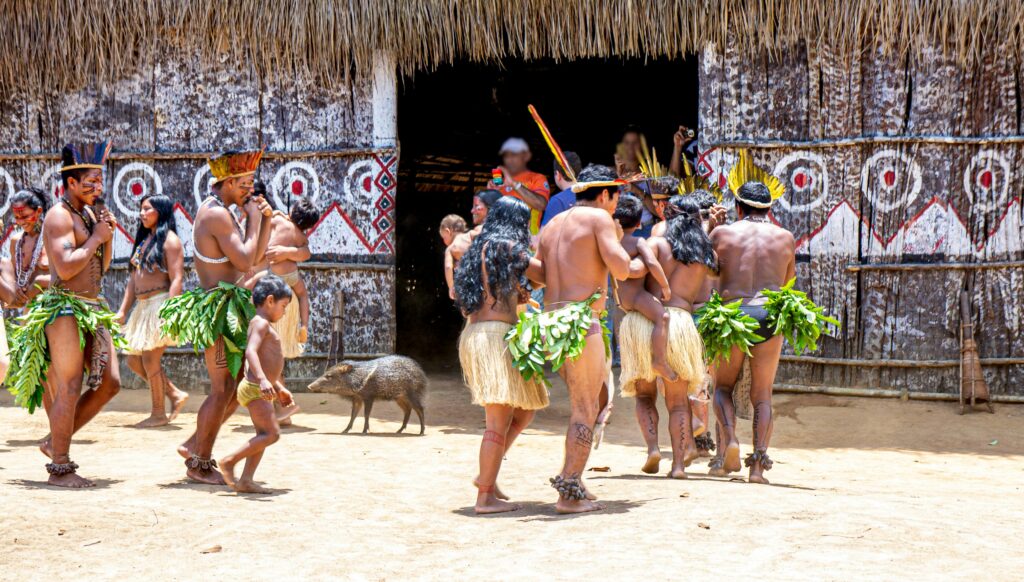
Despite the fact that the forest looks, and in many places actually is impenetrable there still live 34 million people. More or less 400 tribes still live in isolation, who have none or little contact with the outside world. The 34 million inhabitants depend, at least to some extent, of the forest. The jungle is for them a source of food, wood, shelter and in many cases also medicine. Indigenous people manage around 25% of the Amazon jungle. They live in harmony with nature. The biodiversity in these area’s is even higher than in the national parks which also cover around 25%. The indigenous population therefore plays a crucial role in the conservation of the Amazon.